How to Set a Hiking Turnaround Time
Work backward from a return constraint, include the whole return and decide what changes when the walk starts late.
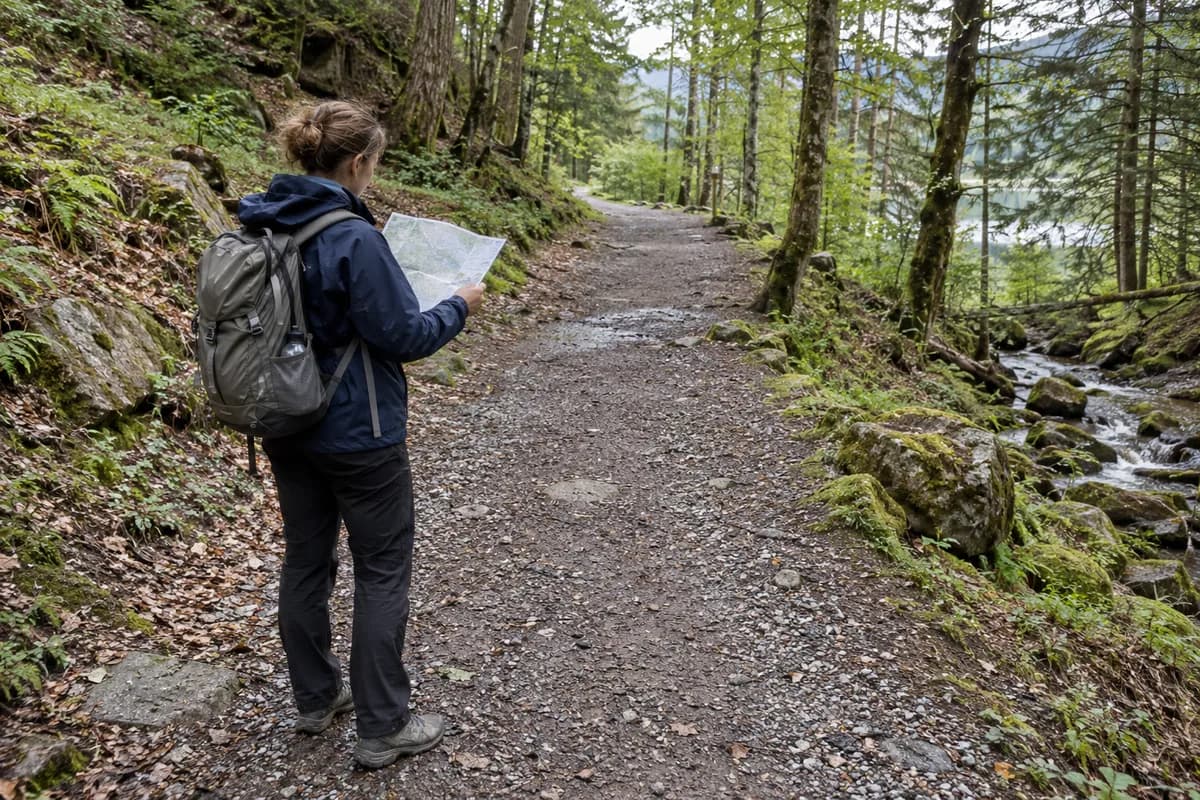
A turnaround time is a preplanned point at which you stop traveling farther away and begin the intended return. Set it from the complete return arrangement, then use earlier checkpoints to notice when the plan no longer fits. It is a limit on the proposed outing, not a prediction that you will finish by a particular time.
The Hawaiʻi Volcanoes National Park hiking guidance tells walkers to know and keep a turnaround time. Its advice is park-specific; it does not supply a universal calculation for every landscape. The example below is original and hypothetical, with assumptions you must replace for a real walk.
Define what “back” actually means
Choose the return event before choosing a target. Reaching a viewpoint, returning to the trailhead, arriving at the bus stop and reaching your accommodation are different events. A plan that ends when the walking track reaches a road can omit the journey that makes the day work.
Write down the relevant constraint and why it exists. It might be a confirmed transport arrangement or a locally advised access limit. Daylight and conditions also matter, but do not invent a general rule by treating one clock time as appropriate everywhere. Use current local information for the actual outing.
A point-to-point route needs its own return logic. “Turn around” does not necessarily describe a workable option once you have traveled along it. Read start, finish and vehicle logistics before applying an out-and-back model to another route shape.
Work backward through a hypothetical day
For this teaching example only, suppose there is a departure at 14:00. The chosen walking finish is assumed to be 30 minutes from that departure point. The draft return walk is estimated at two hours, and the planner leaves another 30 minutes unallocated before the walking finish.
| Backward step | Hypothetical result |
|---|---|
| Departure constraint | 14:00 |
| Subtract 30 minutes to reach the departure point | Walking finish by 13:30 |
| Subtract two hours for the assumed return walk | 11:30 |
| Subtract another 30 minutes left unallocated | Begin the return by 11:00 |
The arithmetic is 14:00 minus 30 minutes minus 120 minutes minus 30 minutes, giving 11:00. None of these durations comes from a real trail, timetable or recommended allowance. They exist to show which parts must be accounted for. The unallocated time is not a guarantee against delay.
Work backward; turn earlier if needed
- 14:00 departure
- 13:30 walking finish
- 11:00 turn
- Conditions or progress change
- Make an earlier decision
The diagram is a synthetic timeline. Its spacing must not be interpreted as a measured elevation or distance profile.
Do not infer the return from the outward journey
The return estimate needs its own basis. Check the direction, terrain, ascent, descent and the route you intend to use. Do not assume it is faster because the destination looks higher, or simply halve a provider's complete duration. First establish whether that duration covers one way, a return or a different track.
If you cannot justify the return estimate, the calculated turnaround time remains an unresolved draft. A precise clock display does not repair an uncertain input. Use the trail-description audit to identify which measurements and route versions are being compared.
In the hypothetical example, the target is optional and the return arrangement is the constraint. A viewpoint that cannot fit the return does not become feasible because you have nearly reached it.
Apply the method to the route-reading example
In the Arthur's Pass route brief, the intended return follows the track. Do not replace it with the main highway to make the clock work: DOC warns against that return.
Before applying the synthetic 11:00 result above, replace its departure, approach and return estimates with information for your actual version and group. Until then, the example has no established clock time. If the track return no longer fits, shorten the outward objective or choose a different verified outing; the unsafe highway return DOC warns against is not the contingency.
The return plan also decides what must remain in the carried pack. Check the day-hike list against an unexpected delay rather than leaving everything beyond the viewpoint in a car or room.
Use checkpoints before the final limit
Pick identifiable decision points from the actual route information. At each one, compare the day so far with the plan: your position, remaining route, people, conditions and the return arrangement. The purpose is to change the plan while choices still exist, rather than discover at the last outward point that the arithmetic was optimistic.
Suppose the same invented day starts 30 minutes late. You cannot automatically move the turnaround from 11:00 to 11:30: the departure has not changed. Instead, reconsider the outward objective, shorten the intended stop or choose the prepared alternative. The relevant change is to the outing, not to the clock label.
Do not treat the time limit as an instruction to continue until it regardless of circumstances. Conditions or a person's situation may call for an earlier change. This article is a planning exercise, not instructions for managing an incident.
Agree what will be removed from the day
Discuss the limit with companions before setting out. Name the optional elements that can go: an extra viewpoint, a long lunch stop or repeated photographic pauses. If everyone assumes that only their own stop is essential, the written limit will not describe the shared plan.
For example, decide that a main photograph stop happens only if the earlier checkpoint leaves room for it. See photo stops without rushing for a way to make that agreement explicit. Removing an optional stop is different from rushing the return or dropping necessary preparation.
Record the return constraint, assumptions, checkpoints and alternative in the trip worksheet. Before using the plan, replace every invented duration with an appropriate current estimate or leave it unresolved. A useful turnaround decision starts with understanding what you must get back to.
What this guide is based on
This guide is researched editorial guidance. A source review does not confirm current local access, road conditions or your individual ability.
- Hiking Tips - Hike Smart ↗Hawaiʻi Volcanoes National Park, NPS · C30-05
Use only park advice about turnaround planning; do not reproduce old clinical, hydration or volcanic-hazard instructions.
- Arthur’s Pass Walking Track ↗New Zealand Department of Conservation · C30-15
Actual route-description reading example; not a recommendation or confirmation of current access, duration or suitability.