Luggage Between Japanese Cities: Carry, Store or Forward?
Separate your journey from your suitcase journey, compare three luggage choices and check train rules, hotel acceptance and delivery timing.
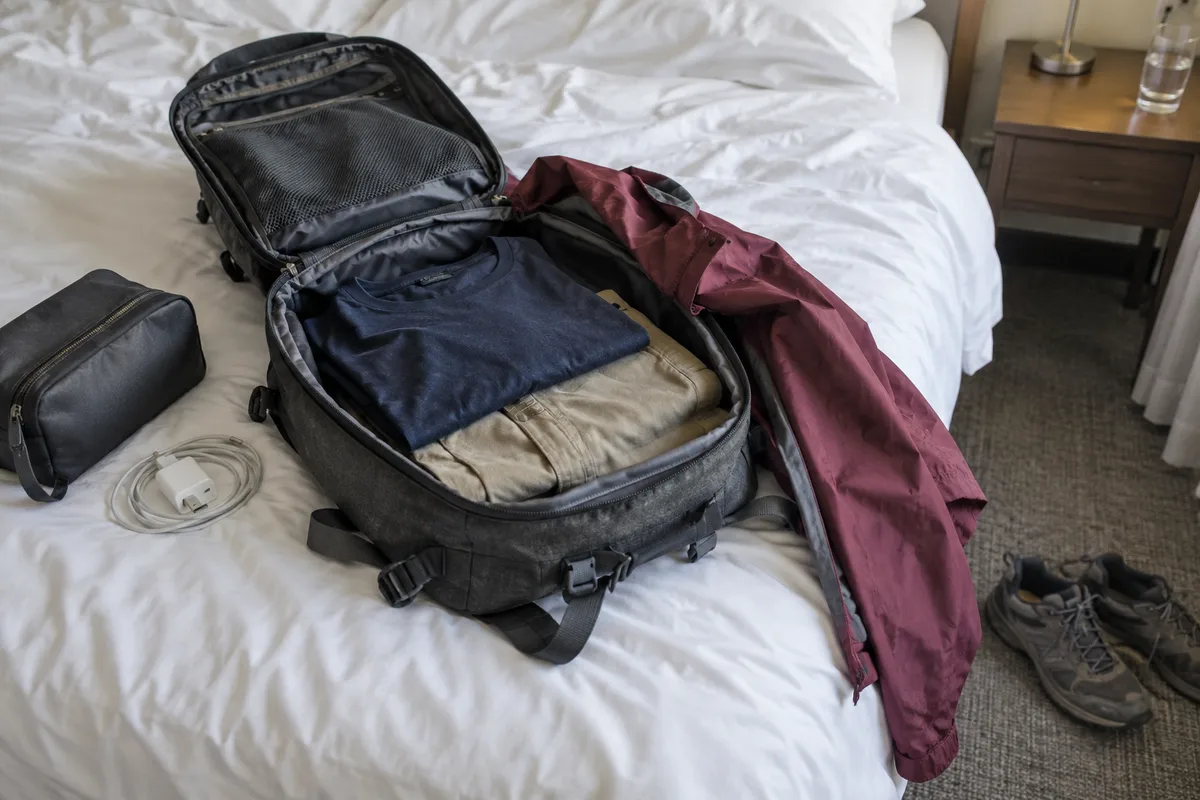
Carry luggage when you can manage it on the complete journey, store it when you will return for it, and consider forwarding when the receiving arrangement and delivery schedule are confirmed. The useful question is not simply whether Japan has luggage delivery. It is whether you will have the bag when you need its contents.
Treat the traveler and the suitcase as two related journeys. They may leave together and arrive together, or take different paths. Your essential belongings must still be available if those paths do not line up as expected. This guide is a planning framework, not a booking or delivery service.
Three choices solve different problems
| Choice | It can help when | What you must settle |
|---|---|---|
| Carry the bag | You want it with you at the next room | Every connection and the actual train's baggage rules |
| Store and collect | The outing returns to the place holding it | Acceptance, collection access and the later onward journey |
| Forward to another place | You want to travel without the main suitcase | Sending service, receiving consent and confirmed delivery arrangement |
Storage does not solve a one-way move unless you also plan the return to collect the bag. Forwarding does not remove planning; it transfers some of it from platforms to collection cutoffs and a receiving address.
The first Japan rail-trip guide explains the whole connection. Here, use that route to decide where the bag becomes a practical constraint rather than choosing a service first.
Measure for the railway you will use
JR Central's current guidance adds the bag's length, width and height. On the Tokaido, Sanyo, Kyushu and Nishi-Kyushu Shinkansen, baggage exceeding 160 cm (63 in) in total dimensions requires the relevant oversized-baggage seat arrangement; items exceeding 250 cm (98 in) cannot be brought aboard. The page also distinguishes deck storage from the reserved space behind designated seats. Do not mistake the availability of a deck-storage trial for removal of the oversized-baggage requirement. JR Central luggage information.
These thresholds are not the full allowance: check the operator's piece-count, weight and maximum-length conditions too. They are operator and service conditions, not one rule for every train in Japan. Check the page for your actual service, unusual equipment and any relevant exceptions. Measure the bag rather than relying on labels such as “large suitcase” or “airline approved.” Ask the operator if the measurement or item category is unclear.
Also consider whether you can move the bag through the journey you have chosen. A compliant bag is not automatically a convenient bag. Your walk to the station, changes and accommodation entrance still belong in the decision. Do not assume an unconfirmed lift or storage space will be available.
Give the suitcase its own timeline
You and your bag may arrive separately
- Traveler departure
- Traveler arrival
- Essentials stay with you
- Bag accepted
- Provider delivery window
- Bag delivered
The separate lines represent different responsibilities. They do not show a promised delivery duration. At each point where the bag leaves your possession, record who has accepted it, where it is going and how you will identify the shipment.
The Tokyo–Kyoto example in the rail guide keeps the same people, rooms and optional intermediate night in both luggage choices. This is its separate suitcase record:
| Handover | Record before committing | What remains with the traveler |
|---|---|---|
| Tokyo sending point | Accepted product/items, actual cutoff, destination label and shipment identification | Travel documents, personal essentials and what the intervening stay requires |
| While travelers change rooms | Who can answer a tracking or delivery question; what happens if dates change | Enough usable equipment/clothing for the confirmed interval without the main bag |
| Kyoto receiving point | Hotel agreement, booking name, receiving/collection limits and any charge | A plan that still works if the suitcase is not available at check-in |
This table provides no dispatch date or delivery duration. An intermediate overnight is not permission to assume a matching delivery window. Ask both the carrier and the receiving accommodation before deciding when to send the bag. If their answers do not fit, carry/store the bag under confirmed arrangements or remove the intermediate stop.
The fallback must exist before the handover: once the suitcase has been accepted for shipment, you cannot assume it can be retrieved for a newly changed train plan.
Ask both ends, not only the carrier
Yamato's accommodation FAQ makes acceptance conditional on the hotel or ryokan agreeing to receive the luggage. It also describes advance cutoffs and warns that collection arrangements can vary. Its linked service context matters, so confirm the appropriate product for your own journey instead of converting the FAQ into a universal next-day promise. Yamato accommodation FAQ.
A useful message to an accommodation might read:
I have a reservation under this name for these dates. Do you accept luggage sent before check-in? Which address and booking details should appear on the label? Are there receiving or collection restrictions? Please confirm any storage charge and what happens if the delivery or our arrival changes.
Ask the sending desk or carrier which cutoff, accepted item rules and tracking method apply. If the two answers do not fit together, resolve the mismatch before handing over the suitcase. A hotel's willingness to help does not independently establish the carrier's delivery schedule.
Decide what stays with you
Build the small bag around the interval in which you may not have the suitcase. Include the items you cannot reasonably do without, your booking and shipment details, and what you need for the next confirmed overnight. Follow the carrier's own restrictions for valuables and other special items rather than assuming all possessions can be shipped together.
For a storage-based day, note the latest collection arrangement you have actually confirmed. For a forwarding-based move, keep the delivery contingency beside the travel plan. Do not make the entire arrival evening depend on a bag reaching the room at an unverified time.
Choose the least complicated confirmed option
If carrying works for your complete journey, forwarding may add more coordination than it removes. If the bag makes every connection awkward and both sending and receiving are confirmed, the separate suitcase journey may be useful. Neither choice is a test of traveling correctly.
Settle your Tokyo or Kyoto base decision before finalizing the receiving destination. For a journey that does not return to its starting point, check the wider point-to-point logistics. Keep the luggage plan with your personal itinerary and recheck it when an address, date, train or overnight changes.
What this guide is based on
This guide is researched editorial guidance. A source review does not confirm current local access, road conditions or your individual ability.
- How to travel by train and bus in Japan ↗Japan National Tourism Organization · A30-01
Urban/rural transport patterns and multiple operators; no timetable or universal ticket validity.
- Luggage information ↗Central Japan Railway Company · A30-03
Current operator-specific luggage sizes/reservations; new deck-storage trial does not remove oversized-space reservations. No claim about every train.
- Can I send parcels to a hotel or ryokan? ↗Yamato Transport · A30-06
Accommodation acceptance and shipping cutoff conditions; English FAQ links round-trip service. Exact itinerary/product must be checked with carrier; no universal next-day claim.